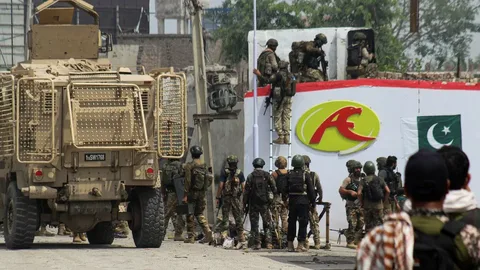
Security forces on Tuesday killed five terrorists during an intelligence-based operation (IBO) in Khyber Pakhtunkhwa’s Bara area, according to security sources. The militants belonged to Fitna al-Khawarij, and the operation was reported by Radio Pakistan. Officials said a large quantity of weapons and ammunition was recovered, and the militants’ hideouts were destroyed. The Bara operation is the latest in a run of counterterrorism actions by security forces in Pakistan this month.
Background: Rising Terrorism in Khyber Pakhtunkhwa
Khyber Pakhtunkhwa has faced repeated militant violence in recent years, especially in districts close to the Afghan border. Attacks on police stations, checkpoints and patrols have become common, and security forces have responded with a steady stream of intelligence-led raids. The Bara operation should be read against this wider pattern of Khyber Pakhtunkhwa terrorism.
The state uses the term Fitna al-Khawarij for militants linked to the banned Tehreek-i-Taliban Pakistan (TTP). Dawn notes that this is the label authorities apply to members of the group. The term now appears in almost every official statement about such operations, so readers of Pakistani news will see it often.
September has been a particularly violent month. On September 19, a blast at a mosque inside the Kohat Police Lines during Friday prayers killed 23 people, including 15 police personnel. On September 20, two officers and four other personnel were martyred in a fire exchange in Hangu, where eight terrorists were also killed. These incidents explain why the pace of operations has picked up.
Details of the Bara Operation
According to security sources, the operation was launched after information about the presence of terrorists in Bara. Troops moved into the area, and the two sides exchanged intense fire. Five militants were killed in the encounter, and no further details about their identities have been released so far.
Security sources said a large quantity of weapons and ammunition was recovered from the killed terrorists. Officials also said the extensive operation completely destroyed the militants’ hideouts in the area. Recovered weapons are usually examined afterwards to trace supply routes and possible links to other cells.
The operation is described as part of ongoing efforts in Khyber Pakhtunkhwa under Operation Azm-e-Istehkam. Security forces say they are committed to removing terrorism from the country and restoring lasting peace. As with most operations of this kind, the account comes from security sources, and independent verification from the ground is limited.
Simultaneous Action in Balochistan
The Bara operation was not the only action reported on Tuesday. In Balochistan’s Chagai district, security forces killed two terrorists in the Nok Kacha area. Sources said the militants, linked to Fitna al-Hindustan, had set an empty water tanker on fire and were trying to flee when forces responded. The same militants were also said to be involved in arson attacks along the N-40 highway. Taken together, the two operations brought the day’s toll to seven militants killed across Khyber Pakhtunkhwa and Balochistan. The timing suggests that security forces are running parallel campaigns on both fronts. Officials say more operations will follow.
Official Reaction and Statements
Prime Minister Shehbaz Sharif praised the security forces for their professionalism, courage and bravery, and said the whole nation stood with them in the fight against terrorism. He also said operations would continue until terrorism was fully eliminated from the country.
Interior Minister Mohsin Naqvi also commended the forces for the operations in Bara and Chagai. He said they had foiled the militants’ “nefarious designs.” He added that the government values the actions taken against the Khawarij and their facilitators, and described such operations as important for protecting the country.
Impact: What the Bara Operation Means
At the regional level, the destruction of hideouts in Bara may make it harder for militants to move and organise around Khyber district and nearby areas. Bara sits close to Peshawar and the tribal belt, so any disruption there can ease pressure on surrounding communities. Local residents will likely watch closely to see whether the area stays calm in the coming weeks.
Nationally, the operation reinforces the message that security forces in Pakistan are pursuing militants on several fronts at once. The action came only two days after the military’s media wing said more than 71 terrorists were killed in Shaban and other parts of Balochistan. The scale of these operations shows how large the current security challenge has become.
There is also a wider regional dimension. Pakistan has repeatedly said that some militant groups operate from across the Afghan border, a claim that continues to shape relations with Kabul. Any lasting improvement in Khyber Pakhtunkhwa terrorism will depend on both military pressure and diplomatic engagement.
Conclusion: What Comes Next
Officials have signalled that operations in Khyber Pakhtunkhwa and Balochistan will continue. Follow-up clearance drives around Bara are likely, along with tighter checks on movement in the surrounding areas. Further statements from the military’s media wing may add detail on the identities of the slain militants.
The larger question is whether operations alone can bring lasting stability. Analysts often argue that intelligence sharing, border management and community trust are as important as force. For now, the Bara operation is another data point in a long and difficult campaign.
Frequently Asked Questions (FAQs)
Is ASF under the army?
No. The Airport Security Force (ASF) is a federal civil armed force responsible for security at Pakistan’s airports and aviation facilities. It is a separate organisation from the Pakistan Army and has its own ranks, recruitment system and command structure. Senior positions in the force have traditionally been filled by officers from the armed forces on deputation, which is why people often assume it is part of the army. Its day-to-day work includes passenger and baggage screening, perimeter protection and counter-sabotage duties at airports.
What are security forces in the army?
The phrase “security forces” is a broad term, and it does not mean only the army. In Pakistan, it generally covers the Pakistan Army, paramilitary forces such as the Frontier Corps and Rangers, and police, along with specialised bodies such as the ASF and the Counter Terrorism Department. In news reports, “security forces” usually points to a joint effort, often led by the army and supported by paramilitary and intelligence units. The army itself is the country’s main land force and takes the lead in large operations, while paramilitary and police units handle local security, border control and law enforcement.
What is ASF salary?
ASF pay follows the federal government’s Basic Pay Scale (BPS), so it depends on the rank and grade of the post. Constables, assistant sub-inspectors, sub-inspectors and officers all fall in different grades, and each receives allowances on top of basic pay. The exact figures change with each government pay revision, so no single number stays accurate for long. For current pay, check the latest official ASF recruitment advertisement or the federal government’s notified pay scales.